

About the Book
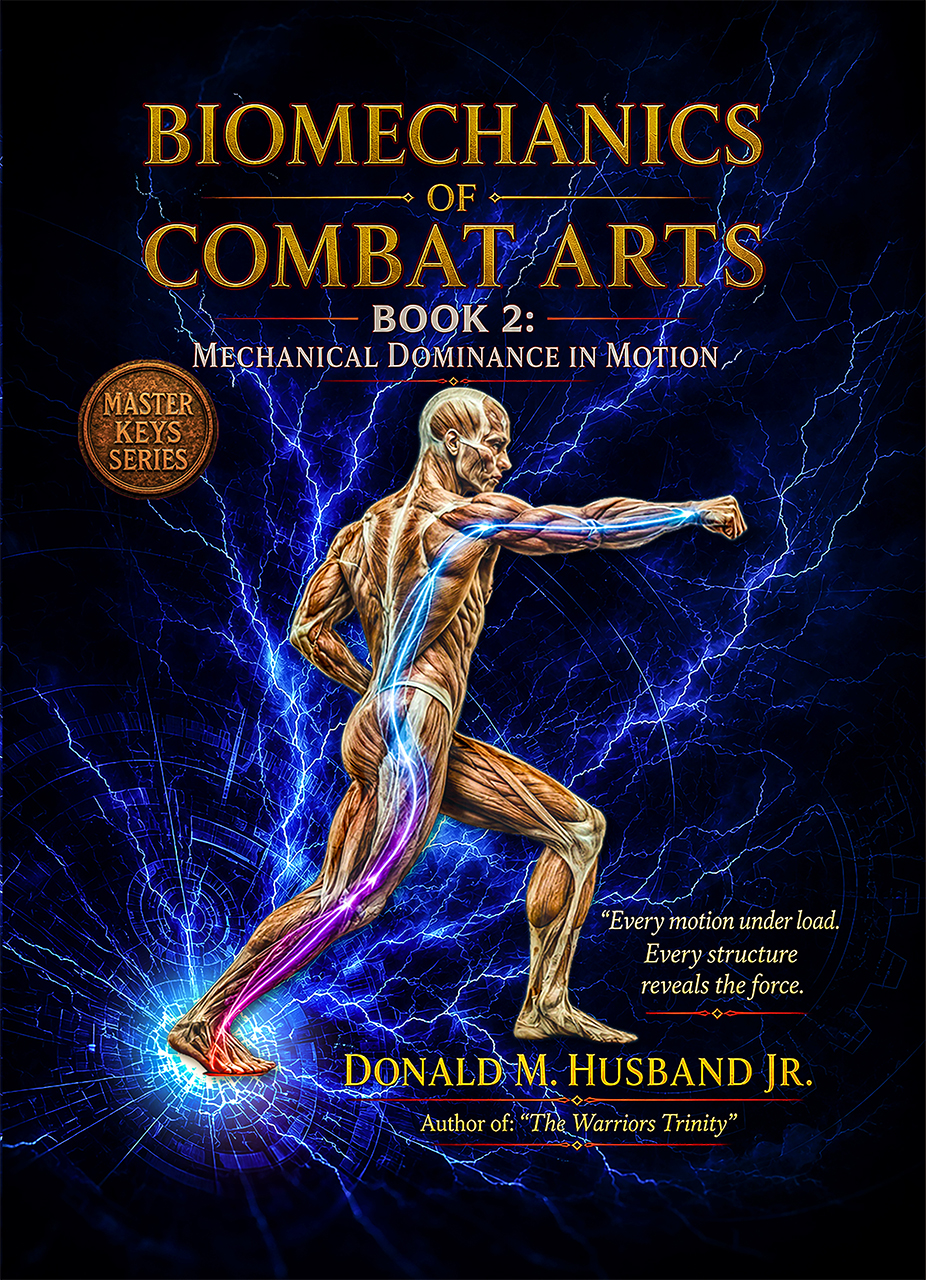
Biomechanics of Combat Arts, Book 2: Mechanical Dominance in Motion begins where Book 1 leaves the reader: with a body whose structure can now be examined under consequence. The question is no longer only how movement is built. The question is what force does when resistance, fatigue, unstable terrain, compressed timing, and continuous opposition begin changing the conditions beneath it.
A strike can look correct and still lose force. A throw can enter on time and still become heavy. A stance can remain upright while its support has already begun to fail. Book 2 follows those changes through the base, hips, torso, limbs, and recovery sequence so that failure is no longer treated as a mystery or dismissed as a lack of effort.
This volume makes force behavior visible. It examines how load accumulates, how alignment distorts, how compensation spreads, and how correction succeeds or arrives too late. The body remains the evidence. Pressure through the feet, delay in the hips, tension in the shoulder, a guard that returns late, or a recovery step that should not have been necessary all reveal where the mechanical pathway changed.
The purpose is not to replace martial practice with abstraction. It is to give practitioners, instructors, and coaches a more exact way to read what is already happening on the floor, against the bag, during sparring, and under resistance.
What This Book Covers
- Tactical physics and the measurement of force, impulse, timing, work, energy, and efficiency in martial movement.
- Center of mass, torque, leverage, moment of inertia, and the regulation of rotation and translation.
- Environmental resistance, terrain, clothing, gear, drag, friction, and the return of stable gait after disruption.
- Biomechanical modeling and simulation as tools for exposing force pathways before visible failure.
- Repeated exposure, fatigue, injury history, and the way small deviations stabilize into recognizable patterns.
- Correction windows, moving failure, overcorrection, continuous recovery, and the final threshold before collapse.
What You Will Learn
You will learn to follow force through movement rather than judging technique only by its outward shape. You will see how a late foot changes the hip, how a delayed hip changes the torso, and how the shoulder often becomes the visible rescuer of a failure that began lower in the chain.
You will learn to distinguish successful completion from clean mechanical transfer. A strike may land, a throw may finish, and a combination may continue while the body is already carrying unresolved load into the next action. Book 2 teaches you to recognize that evidence earlier, locate the first meaningful deviation, and understand whether correction can still preserve the movement.
Most importantly, you will gain a framework for pressure-testing training without confusing effort with proof. The goal is not to accumulate more techniques. It is to make force, compensation, recovery, and collapse readable enough that practice becomes more honest.
Who This Book Is For
- Martial artists who want to understand why techniques change under resistance and fatigue.
- Instructors who need precise language for diagnosing force leaks, timing errors, and structural compensation.
- Combat sports athletes who must preserve output and recovery through repeated exchanges.
- Self-defense practitioners who need mechanics that remain usable when terrain, clothing, distance, and pressure change.
- Coaches and movement specialists who want to connect modeling, measurement, and training design to real martial application.
The Series Continues
Book 1, The Fundamentals, establishes structural literacy through anatomy, fascia, neuromuscular coordination, kinesiology, leverage, and the foundations of force transmission. Book 2 places that structure under pressure and follows the mechanical consequence.
Book 1 built the structure. Book 2 tests it under pressure. Force becomes visible. Collapse becomes predictable. The body tells the truth.
Explore Book 1Available Now
Biomechanics of Combat Arts, Book 2: Mechanical Dominance in Motion was released July 14, 2026 and is available through Amazon and Barnes & Noble.
Order on Amazon Order on Barnes & Noble