

About the Book
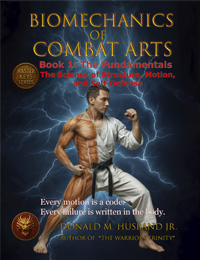
Biomechanics of Combat Arts, Book 1: The Fundamentals is a technical field guide for martial artists who want to understand the structure beneath technique. It examines how bones, joints, muscles, fascia, and the nervous system cooperate to produce movement that remains efficient, durable, and usable under pressure.
Rather than offering another catalogue of techniques, the book explains why movement succeeds, why it fails, and what the body must organize before force can travel cleanly. The reader is taught to see the frame as a connected mechanical system in which alignment, sequencing, leverage, balance, and recovery determine whether effort becomes effective output or disappears through compensation.
Written from the perspective of a lifetime practitioner and instructor, the volume connects anatomy, kinesiology, physics, and real martial application. The goal is not to reduce martial arts to equations. It is to make the physical truth beneath technique visible enough that training can be tested and refined.
What This Book Covers
- Structural alignment, skeletal leverage, and joint integrity under impact and load.
- Muscular sequencing, kinetic chains, and the coordination required for efficient force production.
- Fascial continuity, elastic recoil, and the tension pathways that link distant parts of the body.
- Neuromuscular communication, sensory feedback, predictive coding, and movement correction.
- Kinesiology, geometry, center of mass, dynamic stability, torque, leverage, and ground reaction forces.
- Training design that connects physical preparation to striking, grappling, recovery, and live opposition.
What You Will Learn
You will learn how to read the body beneath the visible technique. You will understand why certain movements feel heavy while others remain connected, why power leaks through misaligned joints, and why the body often compensates long before failure becomes obvious.
You will also learn how base, posture, center of mass, leverage, and sequencing interact so that the body can launch, land, and recover without rebuilding itself after every action. The purpose is not to memorize more terminology. It is to gain structural literacy that can be tested on the floor and under resistance.
Who This Book Is For
- Traditional martial artists who want to test inherited methods against clear mechanical principles.
- Combat sports athletes who need stronger structural integration for striking, clinch work, and grappling.
- Self-defense instructors who must explain why movement works, not only how it looks.
- Strength and conditioning coaches who support fighters and need to align gym work with combat realities.
- Serious students of movement who want a foundation for understanding force under pressure.
Continue the Series
Book 1 establishes the internal architecture of the martial body. Book 2, Mechanical Dominance in Motion, places that architecture under resistance, fatigue, terrain change, timing compression, repeated exposure, and continuous movement.
If Book 1 teaches how structure is built, Book 2 reveals what happens when force tests it.
Continue to Book 2Order Book 1
Biomechanics of Combat Arts, Book 1: The Fundamentals is available through Amazon.
Order on Amazon